How to Choose a Textile Fabric Supplier in Europe: A Practical Guide for Manufacturers
Finding the right textile fabric supplier in Europe is not simply about finding a company that can supply fabric at the right price.
For manufacturers, designers and purchasing teams, the right supplier can have a direct impact on product quality, production efficiency, lead times and long-term reliability.
But how do you choose between different textile manufacturers, fabric suppliers and textile companies in Europe?
The answer depends on much more than the fabric itself.
A good supplier should understand your application, provide consistent quality, communicate clearly and have the technical capabilities to support your production requirements.
In this guide, we explain what to look for when choosing a European textile supplier, what questions you should ask before starting a collaboration and why working directly with a textile manufacturer can make a significant difference.
What should you look for in a European textile supplier?
Before choosing a supplier, it is important to look beyond the product catalogue.
A fabric may look suitable when you see a sample, but its real performance will depend on factors such as construction, composition, weight, finishing, dimensional stability and how consistently it can be manufactured.
The most important factors to evaluate are:
- Product quality and consistency.
- Manufacturing experience.
- Production capacity.
- Technical knowledge.
- Customisation possibilities.
- Lead times and delivery reliability.
- Certifications and quality standards.
- Communication and customer support.
- Experience in your specific industry.
The best fabric supplier in Europe is therefore not necessarily the company offering the lowest price.
It is the supplier that can provide the right material consistently and support your production over time.
Manufacturer or distributor: which is better?
One of the first questions manufacturers should ask is whether they are buying directly from a textile manufacturer or through a distributor.
Both models can have advantages, but working directly with a manufacturer can offer greater control over the development and production process.
A direct textile manufacturer may be able to provide:
- Greater control over fabric specifications.
- More flexibility for customised developments.
- Direct technical communication.
- Better understanding of production processes.
- Faster feedback during product development.
- Greater consistency between production batches.
This can be particularly important when the fabric is not simply a finished product but a component of another product.
For example, manufacturers of footwear, automotive interiors, upholstery, mattresses or technical textile products may require very specific combinations of composition, thickness, weight, softness, strength or finishing.
In these cases, having direct communication with the manufacturer can make product development significantly easier.
What types of fabrics does the supplier manufacture?
Another important consideration is the supplier’s actual manufacturing expertise.
A company may describe itself as a fabric supplier in Europe, but that does not necessarily mean it manufactures the fabrics itself.
Before starting a relationship, ask:
What types of fabrics do you manufacture?
Depending on your application, you may need specific textile constructions such as:
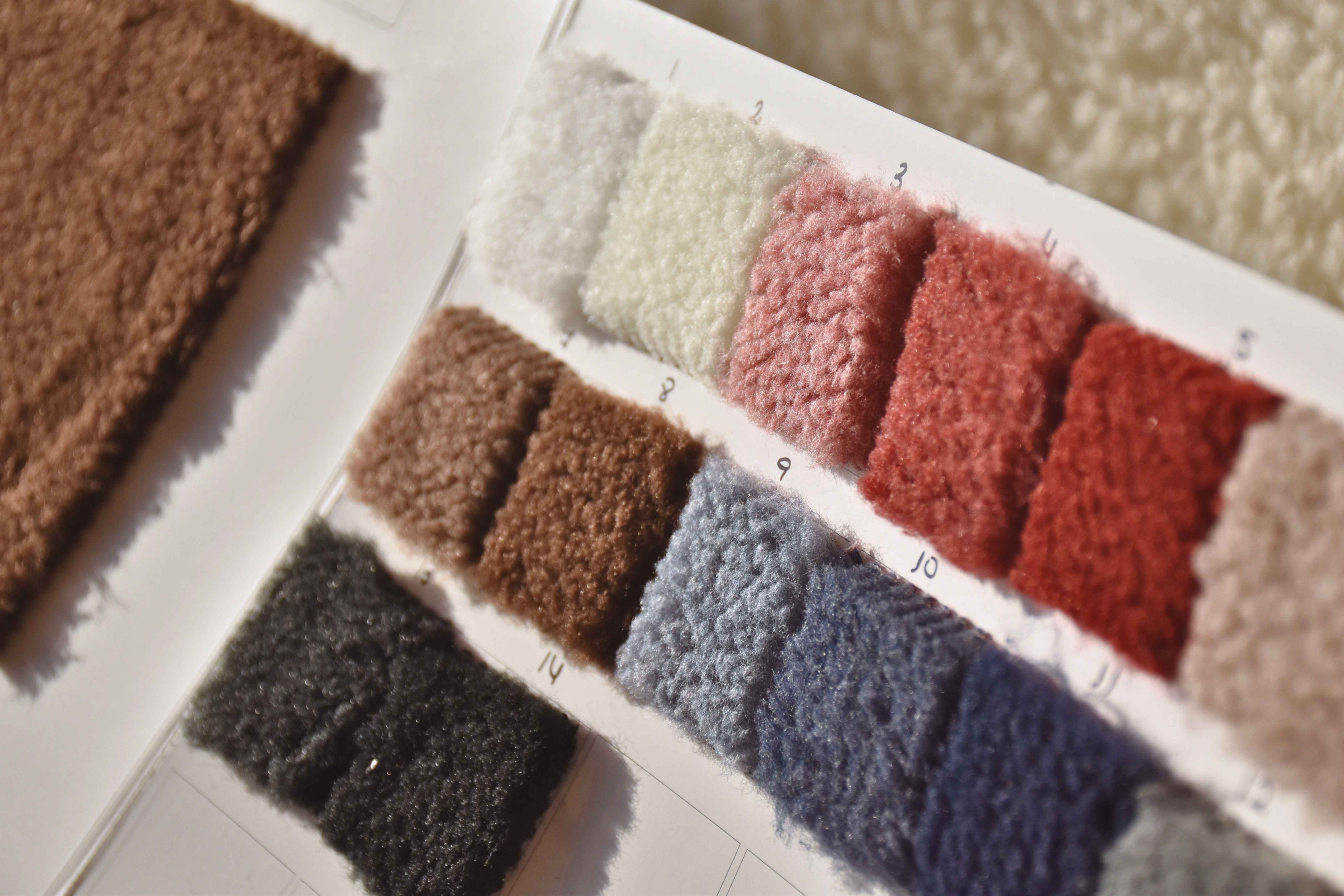
- Pile fabrics.
- Sherpa or shearling-effect fabrics.
- Cotton fabrics.
- Polyester fabrics.
- Jacquard fabrics.
- Recycled textiles.
- Technical fabrics.
- Fabrics for footwear.
- Upholstery fabrics.
- Fabrics suitable for lamination.
- Custom-developed textile materials.
The supplier should also be able to explain the technical characteristics of the fabric rather than simply providing a catalogue.
Does the supplier understand your industry?
This is one of the most important questions to ask.
A textile fabric can be technically excellent but still unsuitable for a particular manufacturing process.
For example, a fabric intended for footwear manufacturing may need to perform differently from a textile used for automotive upholstery.
Similarly, a material for a mattress, technical product or upholstered component may have completely different requirements.
A supplier with experience in your industry is more likely to understand these differences.
For this reason, manufacturers should look for a textile supplier with application-specific experience, rather than simply searching for the largest textile company.
What makes a good textile supplier for footwear?
Footwear manufacturers often require fabrics with a combination of softness, resistance, flexibility, dimensional stability and good behaviour during cutting, sewing or assembly.
Depending on the product, manufacturers may also require:
- Pile fabrics.
- Cotton textiles.
- Warm winter fabrics.
- Sherpa-effect fabrics.
- Technical linings.
- Laminated fabrics.
- Custom colours and constructions.
A supplier experienced in footwear can therefore provide more than fabric: they can help identify which textile construction is most appropriate for the final product.
Can the textile supplier develop a custom fabric?
Not every project can be solved with an existing catalogue fabric.
Sometimes a manufacturer needs a specific:
- Composition.
- Weight.
- Thickness.
- Width.
- Colour.
- Surface effect.
- Softness.
- Backing.
- Technical finish.
This is where custom textile development becomes particularly valuable.
When evaluating a European textile manufacturer, ask whether they can modify an existing construction or develop a completely new textile according to your specifications.
A supplier capable of development can become a long-term manufacturing partner rather than simply a source of standard fabrics.
What about textile lamination and bonded fabrics?
For some applications, the fabric itself is only one part of the final material.
It may need to be combined with another layer through textile lamination or fabric bonding.
For example, a textile can be laminated with:
- Flexible foam.
- Latex-based materials.
- Technical films.
- Other textile layers.
This is particularly relevant for automotive upholstery, footwear, upholstery, mattresses and technical applications.
If your final product requires a laminated material, it can be advantageous to work with a supplier that understands both textile manufacturing and lamination processes.
Instead of coordinating several different companies, manufacturers can potentially develop the complete textile construction with a single specialised partner.
How important are lead times and production reliability?
Price is important, but an inexpensive fabric is not necessarily economical if deliveries are inconsistent.
For manufacturers, production delays can result in:
- Delayed orders.
- Production stoppages.
- Additional transport costs.
- Missed delivery dates.
- Problems with customers.
When comparing European fabric suppliers, ask about their typical production and delivery times and, more importantly, how consistently they can maintain them.
A reliable supplier should be transparent about:
MOQ → production time → quality control → dispatch → delivery
This becomes particularly important when fabrics are manufactured specifically for your company.
Should you choose a European textile manufacturer?
For companies purchasing within Europe, sourcing from a European textile manufacturer can offer practical advantages.
Proximity can simplify communication, sampling, development and logistics.
It can also make it easier to visit the manufacturing facility, discuss technical requirements directly and resolve issues during product development.
For European manufacturers, suppliers located within Europe can therefore become valuable partners when responsiveness and production flexibility are important.
Spain, Italy, Portugal, Germany and other European countries have established textile manufacturing industries, but the most suitable supplier will depend on the type of fabric and application required.
What questions should you ask a textile fabric supplier?
Before choosing a supplier, we recommend asking these questions:
1. Are you the manufacturer or a distributor?
This helps you understand how much control the company has over production.
2. Where is the fabric manufactured?
The manufacturing location can affect lead times, logistics and communication.
3. Can you provide samples?
Sampling is essential before approving a material for production.
4. Can you customise the fabric?
Ask about composition, weight, colour, construction, finishing and other technical specifications.
5. What industries do you supply?
Experience in your sector can be extremely valuable.
6. Can you laminate or bond the fabric?
This can simplify the supply chain if your product requires a composite material.
7. What are your minimum order quantities?
MOQ can be particularly important during product development or when introducing a new material.
8. How do you control quality between production batches?
Consistency is just as important as the quality of the initial sample.
How do you compare textile suppliers?
A simple way to compare potential suppliers is to evaluate them across five areas:
| Factor | What to evaluate |
|---|---|
| Quality | Consistency, construction and performance |
| Technical capability | Development, customisation and finishing |
| Production | Capacity, MOQ and lead times |
| Communication | Response time and technical support |
| Experience | Knowledge of your industry and application |
This approach can help you avoid choosing a supplier based solely on price.
The cheapest fabric is rarely the cheapest solution if it creates problems during manufacturing.
Why experience matters when choosing a fabric supplier
Textile manufacturing involves many variables.
The same composition can behave differently depending on the construction, yarn, density, finishing and manufacturing process.
This is why experience matters.
An experienced textile manufacturer can identify potential problems earlier, recommend alternative constructions and help adapt the material to the final application.
For manufacturers developing new products, this technical knowledge can save considerable time during the sampling and production process.
Choosing a textile supplier in Europe: the final decision
The right textile fabric supplier in Europe should not simply sell you fabric.
They should understand what you are manufacturing, why you need the material and what the finished product needs to achieve.
Look for a supplier that combines:
Manufacturing experience + technical knowledge + consistent quality + flexibility + reliable communication.
This combination is particularly important when developing fabrics for demanding applications such as footwear, automotive upholstery, furniture, mattresses and technical textiles.
Why work with Textigor?
At Textigor, we combine textile manufacturing experience with the development of fabrics for different industrial applications.
We work with manufacturers and companies looking for textile fabrics, custom textile solutions and laminated materials, adapting the material to the technical and commercial requirements of each project.